Marketplace scams: How to recognize scam behind a truck for sale ad



Buying a truck, trailer, or piece of heavy equipment online can save time and help you find the right vehicle faster. But every marketplace communication and/or transaction deserves careful attention, especially when a seller asks for money before you have verified the equipment.
Most scams don't start with an obviously suspicious message. They often begin with an attractive listing, a professional-looking profile, and a price that seems like a great opportunity.
The attractive listing
Imagine that a buyer finds a 2019 sleeper listed well below the usual market price. The photos are clear, the description looks professional, and the seller says the truck is located nearby.
The buyer sends a message. The seller responds quickly:
There is already strong interest. Send a deposit today, and I will reserve the truck for you.
The seller may then provide a bank account, payment-app address, or link to a payment page. After receiving the deposit, the seller stops responding or claims that another fee is required before the equipment can be released.
This is a common advance-payment pattern. The equipment may not belong to the seller, may not exist at the stated location, or may be copied from a legitimate and well-known dealer’s listing.
The Federal Bureau of Investigation (FBI) warns buyers to be especially cautious when a deal seems unusually cheap, the seller insists on communicating outside the official platform, or requests payment through unprotected methods (such as direct bank transfers, cryptocurrency, or gift cards). The U.S. Federal Trade Commission (FTC) also warns that scammers fake online vehicle listings and seller identities, and it outlines the “red flags” that should make you walk away from a purchase.
How marketplace scams work
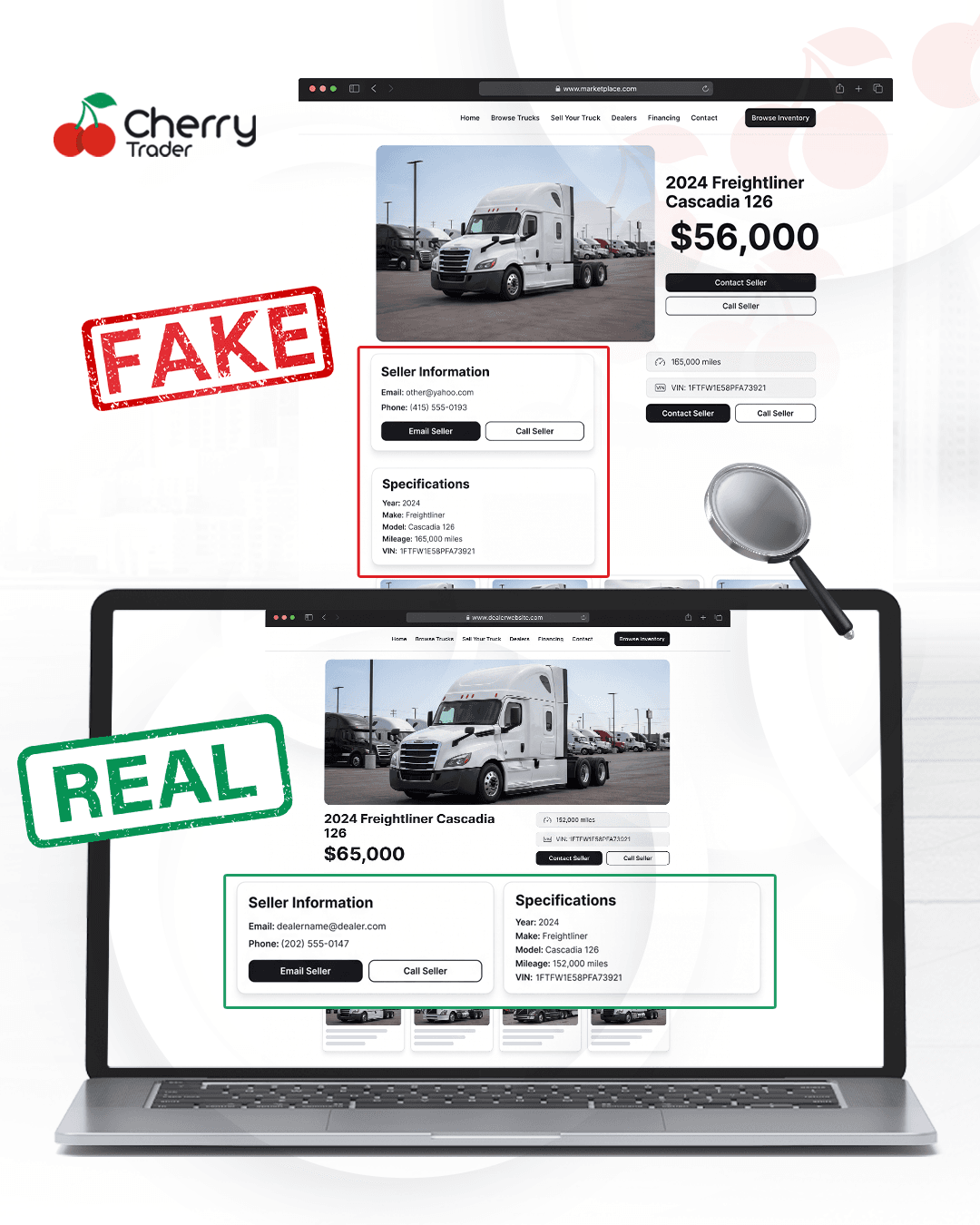
1. Stolen or copied listings
A scammer may copy photographs, descriptions, VINs, serial numbers, and company information from a real dealer or some owner-operator. They can also slightly change details to make it harder to find on other marketplaces. The listing can look authentic because the equipment may be real, but the person offering it may not have authorization to sell it.
The scammer’s goal is to make the buyer trust the listing quickly, before the buyer researches, finds, and/or contacts the real owner.
2. Deposit scams
The seller may ask for a deposit to:
- Reserve the equipment.
- Pay transportation or insurance.
- Cover customs or paperwork.
- Prove that the buyer is serious.
- Release the truck from a warehouse.
- Complete a supposed financing or escrow process.
IMPORTANT: A deposit is not automatically proof of fraud. However, a buyer should slow down when payment is requested before verifying ownership, equipment location, seller identity, and transaction terms.
3. False urgency
Scammers often create pressure:
Another buyer is ready to pay.
The price is valid only today.
Send the deposit within the next hour.
Pressure creates urgency and reduces the time available for inspections and verification. A legitimate seller should be able to clearly explain the transaction and give the buyer enough time to do their own research using tools such as the FMCSA, NHTSA, or a simple Google search.
4. Payment diversion
A seller may list a company name but request payment to a different person, an unrelated company, a foreign account, a cryptocurrency wallet, a gift card, or an unprotected payment service.
The FBI and FTC recommend avoiding payment methods that provide little or no buyer protection, including gift cards, cryptocurrency, and certain direct transfers. Safer options may include a credit card or a secure payment system with buyer protection, depending on the transaction.
5. Fake documents and identities
A scammer may send a copied business license, invoice, identity document, vehicle title, inspection report, or company email. Documents can look convincing but may contain mismatched names, incorrect addresses, altered numbers, or contact details controlled by the scammer.
Never rely on a document alone. Verify the information through an independent source, such as contacting the business or individual using contact details from their official website or public records, or checking relevant government or industry registries.
How to protect yourself
Disclaimer: No online platform can guarantee absolute protection against fraud, fake listings, or malicious users. While Cherry Trader takes reasonable measures to identify and address suspicious activity, users should exercise independent judgment, remain vigilant, and understand the risks involved in online transactions.
The safety of each transaction depends in part on the buyer’s and seller’s own judgment, caution, and informed decision-making. Before sending a deposit, payment, or sensitive information, users should independently verify the other party’s identity, the seller’s ownership of or authority to represent the equipment, the accuracy of the listing details, and the payment terms.
Verify the seller
Before moving forward, verify who you are dealing with.
If the seller represents a dealership, company, broker, or other business, confirm that the person you are communicating with is actually associated with that business. Do not use only the phone number or email address provided in the listing.
Search online for the site’s or seller’s name plus words like “complaint” or “review,” and check several sources, not just star ratings, which can be fake or misleading.
Ask questions about the equipment, its location, ownership, availability, and the seller's relationship to the equipment.
If the answers change, do not add up, or cannot be independently confirmed, take a step back before continuing.
Before sending money, check:
- The legal company name and physical address.
- The seller’s phone number and business email.
- Whether the company has an established online presence.
- Whether the company name, phone number, email, and payment details match.
- Whether the seller is authorized to represent the equipment.
If you find an interesting listing on Cherry Trader, use our dedicated Dealers page to verify the business, its contact information, website, and social media channels; check reviews from past customers, browse their past listings, and see when they joined the platform, so you can be sure the listing is from a verified dealer.
Verify the equipment
The equipment itself deserves just as much attention as the seller.
For trucks and other vehicles, ask for the VIN and make sure it matches the advertised equipment. For trailers and heavy equipment, verify the appropriate identification numbers, serial numbers, make, model, year, and other identifying information.
Services like CARFAX and AutoCheck aggregate data from DMVs, insurance companies, police departments, auto auctions, and repair shops to compile a vehicle’s history. By running a history check or ordering a vehicle history report, you can see details such as past accidents, previous ownership and registration history, maintenance records, and other key events in the vehicle’s life.
Do not assume that because information appears in a listing, it has automatically been verified.
Compare information from multiple sources whenever possible. If something does not match, ask the seller to explain the discrepancy before proceeding.
Arrange an in-person inspection or use an independent inspector. A live video call can help, but it is not a substitute for independent verification.
Compare the listing information
Check whether the same photos or wording appear elsewhere online. You can do this by pasting the VIN into your browser or visiting other marketplaces and checking whether they offer a VIN filter. Look for:
- Different seller names.
- Different locations.
- Different prices.
- Repeated photographs.
- Contact details that do not match the company shown in the listing.
- VINs or serial numbers associated with another seller.
If the equipment appears on several websites under different seller identities, stop and investigate before proceeding.
Be careful with deposits
Deposits can be a normal part of legitimate equipment transactions. The problem is when buyers are pressured to send money before they have had a reasonable opportunity to verify the transaction.
Example: A trailer listed at $18,000 when similar trailers typically sell for around $25,000 isn't a bargain; it's a reason to slow down. If the seller says the company is closing and asks for a $2,000 deposit to hold it, don't send it yet. Run a quick Cherry Market Rate check first to confirm the price actually makes sense. The Cherry Market Rate tool, based on over 140k real transactions, will answer the question, “Is this vehicle price in line with the current market?”
Before sending a deposit, make sure you understand what the payment is for, who is receiving it, whether the seller is authorized to sell the equipment, and what happens if the transaction does not move forward.
Be particularly careful with payment methods that may be difficult to reverse or recover.
Do not pay using gift cards, cash reload cards, or cryptocurrency, and avoid wiring money to someone you don’t know or whose identity you can’t verify. FTC guidance on avoiding scams provides additional information on payment methods and common scam tactics.
If you suspect a scam
Stop communication and do not send additional money. Save the listing URL, screenshots, messages, phone numbers, email addresses, payment instructions, VINs, serial numbers, and any documents the seller provides.
1. If you think you’ve been scammed (confirmed or likely fraud)
-
Contact your bank or payment provider immediately and ask if they can stop or reverse the transaction.
-
File a report with your local police. A police report is often required by banks, payment processors, and marketplaces.
-
Report the fraud to the appropriate U.S. authorities:
-
Report the listing and account to the marketplace where you found it, and share your police/complaint reference if you have one.
On Cherry Trader: If you have reported to police or filed with the FTC/FBI/FMCSA, notify Cherry Trader right away at (224) 220-0932 or support@cherrytrader.com, including your report/complaint number and evidence. Cherry Trader will review and, where appropriate and in line with its policies and applicable law, may suspend or remove accounts or listings and will cooperate with authorities.
2. If you only suspect suspicious activity (no confirmed loss)
You may still contact Cherry Trader at (224) 220-0932 or support@cherrytrader.com with details and evidence. Cherry Trader will assess the information and may take preventive measures, but it cannot guarantee that its assessment will prevent all potential fraud or errors in judgment.
The safest rule
A professional-looking listing does not prove the seller owns the equipment. A low price doesn't prove a good deal. And a request for a deposit should never replace independent verification.
Take your time, verify the seller and equipment through separate sources, use protected payment methods, and report suspicious activity before another buyer becomes a victim.

Get the Latest Blog Updates
Subscribe to receive new articles, guides, and industry insights from Cherry Trader directly in your inbox. Stay ahead with the latest trends and tips for buying, selling, and managing equipment.